
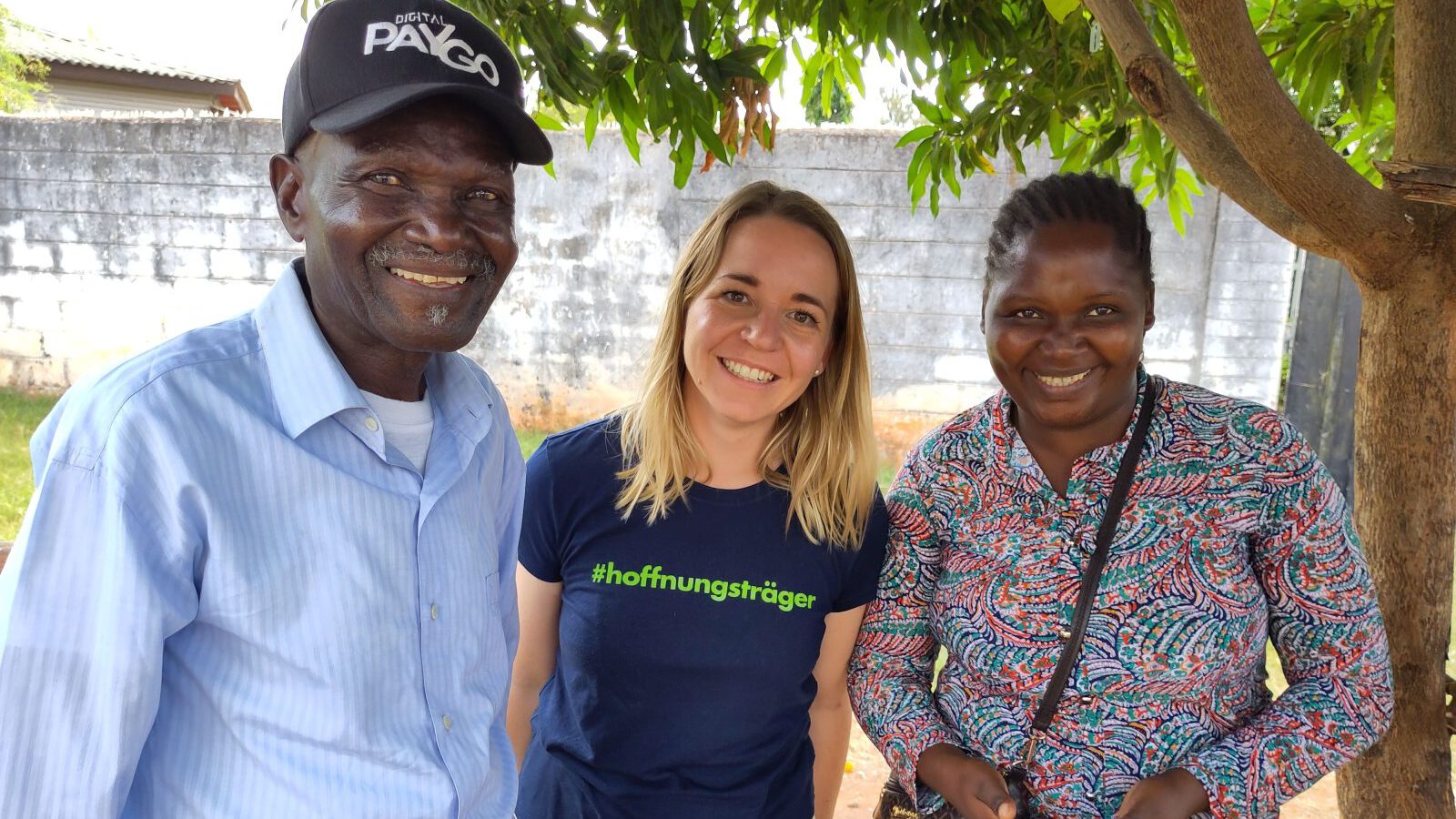
Leonie Löwenstein Bezerra works in the Programme Management team within Hoffnungsträger’s Global Impact division. In an interview, she shares personal insights into her work and talks about her visit to the Child Sponsorship Programme in Zambia.
Leonie, how long have you been with the Hoffnungsträger Foundation?
I’ve been with Hoffnungsträger since 2018; I started as Project Manager and Assistant to the Executive Board. For several years now, I have been Programme Manager, supporting our international and national programme partners.
What is your typical working day like?
In my day-to-day work, I am in constant contact with our partners. I have many meetings with local organisations. I also plan for the coming months to drive our programmes and projects forward.
What connects you to the Child Sponsorship Programme?
Our partner organisation is Prison Fellowship International (PFI). PFI also includes subsidiary organisations in various countries. I am in regular contact with them and we work together to further develop the Child Sponsorship Programme. In the event of exceptional circumstances and challenges, I act as the point of contact and work with our partners to find solutions. In recent years, this has included, for example, the floods in Cambodia, the severe droughts in Zambia, or dealing with COVID-19 measures – in short, everything that affects the day-to-day running of the programme. I also make regular on-site project visits, during which I meet the coordinators of the Child Sponsorship Programme and visit families.
“It really touches me when I hear the family stories of the mums and grandmothers. It gives the programme a face for me!”
What was part of the project trip to Zambia in 2024?
We visited families who are also taking part in the Home Harvest Programme. To explain: Home Harvest is a project that helps people help themselves, enabling families to grow their own vegetables. This allows them to earn their own income. It was lovely for me to see how the programme allowed the women to provide for themselves and their children and not become so heavily dependent on others. Ruth* is one of the many examples that still remain vivid in my memory: she has three children of her own, and her husband is in prison. In Zambia, they owned their own house. Unfortunately, however, the roof was in a very dilapidated state. Ruth tried to plug the holes with rubbish she had collected, but the risk of the roof collapsing grew ever greater, so the family had to flee their home and eventually found refuge in the local community centre. Despite all the challenges, Ruth never stopped looking positively towards the future. She really touched me! Through the programme, Ruth was also given a plot in the community garden and can now grow her own vegetables, which she in turn sells at the local market.
We also attended the graduation ceremony for the sewing school programme. In Ndola, I then visited the regional office of our project partner and met with the Managing Director.
How did you experience the Child Sponsorship Programme on the ground? What made a particular impression on you? What would you like to change?
Whilst I was there, I was once again struck by what it means to each and every child, at the end of the day, to be part of the Child Sponsorship Programme: to be seen and valued.
I was particularly moved by the afternoon when we visited the sponsored children and they sang a song for us (Editor’s note: The song is about God’s love):
Bemba (National language Zambia):
Ichibusa Ichiweme Ba Yahweh, Ba Yahweh, Ba Yahweh Aba mweo.
Ine Nganalwala Ba Yahweh, Balamposha Ba Yahweh, Ndasangalala Ba Yahweh Aba Mweo.
Englisch:
The friendship we have with Yahweh is good. Yahweh, the Creator of life…
When we are ill, Yahweh heals us…
And we are happy and praise Yahweh.
The support for the children on the ground is excellent. We want to ensure the programme is sustainable and are therefore considering how to structure it in the future: we do not just want to support individual children, but to empower the whole family to provide for themselves.
Watch the video: sponsored children from the programme sing a song
How do you assess the current situation on the ground? What do children in Zambia need most?
Zambia has been experiencing extreme water shortages for almost two years. Experts say it is the worst drought in over 40 years. At the moment, many families are trying to get by on one meal a day. Added to this is the problem with the energy supply: on average, electricity is only available for seven hours a day! During my visit to the area, it became clear once again that basic foodstuffs are needed above all else to ensure children have enough to eat and drink. It must be terrible for children who aren’t in the programme!
What is your conclusion when you look back on your trip to Zambia and the local Child Sponsorship Programme?
It encourages and motivates me to be able to support families and children in my daily work! It is a matter close to my heart to stand up for children whose fathers are in prison. They are often stigmatised because of this. In Zambia, the effects of climate change are also clearly visible through severe droughts and crop failures. Because the reservoirs are no longer sufficiently full, there are power cuts. Zambia is one of the countries where the consequences are particularly acute. I see it as my responsibility to stand up for these people.
Thank you very much for the interview, Leonie!
The interview was conducted by Dagmar B..
*Name changed to protect the individual